

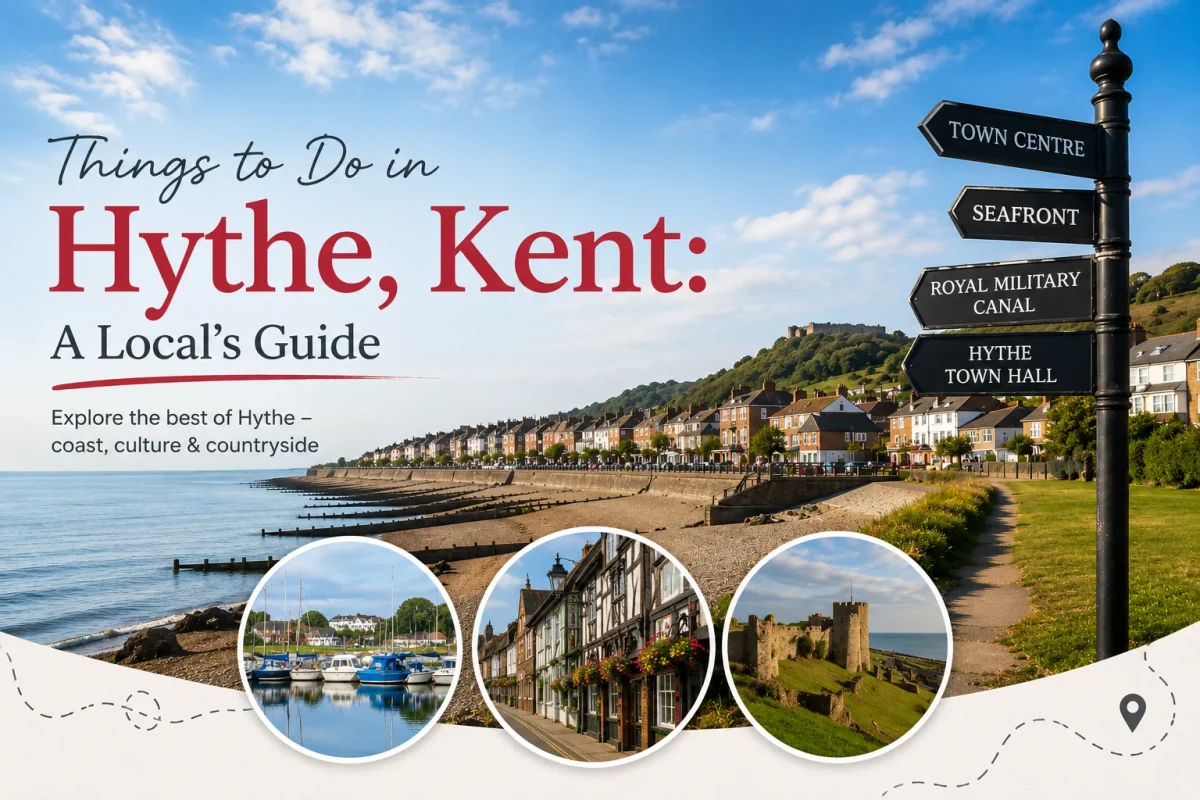
The best things to do in Hythe, Kent are walking the Royal Military Canal, riding the Romney, Hythe and Dymchurch Railway down to Dungeness, spending an afternoon on the shingle beach, seeing the ossuary under St Leonard’s Church and pottering along the independent High Street.
Almost all of it sits within a fifteen minute walk of the town centre. A short drive adds Port Lympne, Folkestone and the Kent Downs. One day covers the town. A weekend covers the town, the Marsh and the coast, without rushing any of it.
Hythe at a glance
Hythe is a small Cinque Port town on the east Kent coast, sitting between Folkestone and the flat expanse of Romney Marsh. The town runs in narrow bands from the sea up to the hills, which is why so much of it is walkable.
| Hythe, Kent | |
| Where it is | East Kent coast, between Folkestone and Romney Marsh |
| Nearest towns | Folkestone (about 4 miles), Ashford (about 13 miles), Canterbury (about 16 miles) |
| The beach | Shingle, with sand exposed at low tide |
| Best known for | The Royal Military Canal, the world’s smallest public railway and its Cinque Port history |
| Nearest station | Sandling, about 2 miles north of the High Street |
| How long to allow | A day for the town, a weekend for the wider coast |
| Where to base yourself | The Red Lion, a pub with rooms on the High Street, minutes from the canal and the beach |
The 12 best things to do in Hythe, Kent
This list is ordered roughly by how close each one is to the middle of town. The first five you can do on foot from the High Street. The rest are a short drive or a train ride away.
1. Walk the Royal Military Canal
The canal is the thing people remember about Hythe. It was dug between 1804 and 1809 as a defence against a Napoleonic invasion that never came, and it now runs for roughly 28 miles from Seabrook, near Folkestone, west to Cliff End in East Sussex.
The Hythe stretch is the prettiest of the lot. It is tree lined, flat, and busy with swans, moorhens and the odd heron. You can pick it up behind the High Street and walk as far as you fancy, then turn round when you have had enough.
Pedalos and rowing boats usually run on the town section over the warmer months. If you would rather stay on land, the towpath is buggy friendly and mostly step free. It is easily the best free thing to do in Hythe, and it is two minutes from our front door.
2. Ride the Romney, Hythe and Dymchurch Railway
Hythe is the northern terminus of the Romney, Hythe and Dymchurch Railway, a 15 inch gauge line that has been running since 1927 and still calls itself the world’s smallest public railway. The locomotives are a third of full size and steam hauled on most services.
The full run is 13.5 miles to Dungeness, taking a little over an hour each way. You do not have to do the whole thing. Dymchurch is a good short hop with the kids, and New Romney has the model railway exhibition and a cafe if you want a halfway point.
Services thin out considerably outside the main season, so check the timetable before you build a day around it. Book ahead in August.
3. Spend an afternoon on Hythe beach and the seafront
Hythe beach is shingle, which is worth knowing before you turn up with a bucket and spade. At low tide a good width of firm sand appears, and the water shelves gently, which makes it easier going with small children than the pebbles suggest.
The promenade runs for a couple of miles with beach huts, benches and a decent view across to France on a clear day. It is a working coast rather than a resort, and it stays quiet even in August compared with the bigger Kent beaches.
One local point that catches visitors out. West of the town are the Hythe Ranges, an active military firing range, and the coastal path is closed when the red flags are flying. Look for the flags and the signs, and take the inland route on those days.
4. See the ossuary at St Leonard’s Church
Up the hill behind the town, St Leonard’s is a large Norman church with a strange and rather brilliant secret in its crypt. The ambulatory holds an ossuary containing around a thousand skulls and thousands of thigh bones, stacked and shelved, thought to have been cleared from the churchyard in medieval times.
It is one of only two surviving ossuaries of its kind in Britain. The climb up Church Hill is steep but short, and the view back over the rooftops to the sea is worth the effort on its own.
Opening is seasonal and there is usually a small admission charge for the crypt, so check before you set out. If macabre history is your sort of thing, we have written more about that side of the town in our guide to hidden gems in Hythe.
5. Browse the High Street and the town market
Hythe High Street has held on to its independents in a way a lot of Kent towns have not. There are butchers, greengrocers, bookshops, galleries and a run of charity shops that reward a proper rummage. An hour disappears easily.
A market runs regularly in the town, with local produce, bread and cheese among the stalls. Days do shift with the season, so check locally before you plan around it. When you are done, the places to eat in Hythe are mostly on or just off this street, ourselves included.
6. Walk up to Saltwood and Brockhill Country Park
A mile or so inland, Saltwood is a village of flint cottages with a castle at its heart. Saltwood Castle is privately owned and rarely open, but the exterior is visible from the lane, and it carries a genuinely famous piece of history: the knights who murdered Thomas Becket in Canterbury in 1170 are said to have gathered here the night before.
Nearby, Brockhill Country Park gives you a wooded valley, a lake and a stream, with waymarked paths and space for children to run about. Parking is straightforward and there is usually a cafe open in season.
7. Meet the animals at Port Lympne Reserve
Fifteen minutes west, Port Lympne Reserve spreads over hundreds of acres of the escarpment above Romney Marsh, with gorillas, black rhino, big cats and a safari truck experience across the open enclosures.
It is a full day out and priced accordingly, so book online in advance and go early. The views south across the Marsh from the top of the reserve are some of the best in Kent and cost nothing extra.
8. Take the coast path east to Sandgate and Folkestone
The seafront path runs east from Hythe past Seabrook to Sandgate, a small village of antiques shops and a good pub or two. It is around three miles, flat, and pleasant in either direction.
Keep going and you reach Folkestone, which has changed a lot. The Harbour Arm is now a run of bars and food stalls out along the old railway pier, the Creative Quarter is full of independent studios, and Folkestone Artworks scatters permanent public sculpture across the town for free.
9. Ride out to Dungeness and Romney Marsh
Dungeness is not like anywhere else in England. It is a vast shingle headland, scattered with fishermen’s huts, two lighthouses, a decommissioned power station and Derek Jarman’s Prospect Cottage with its famous garden, visible from the road.
Birdwatchers should build in time for RSPB Dungeness, which sits on the migration route and gets remarkable passage numbers in spring and autumn. The light out there is strange and flat, and photographers tend to lose an afternoon to it.
The Marsh in between is worth slowing down for, with its medieval churches, drainage dykes and enormous skies. Getting there by the little railway is more fun than driving.
10. Get up onto the Kent Downs
Hythe sits at the foot of the Kent Downs National Landscape, and the escarpment behind the town gives you chalk grassland, orchids in early summer and long views over the Marsh to Dungeness. The path up from Lympne is the classic one.
Lympne Castle sits on the edge of the ridge and is used mainly for weddings and events, but the churchyard beside it is open and the view from that spot is the one people photograph.
11. Catch the Venetian Fete if the dates line up
Every couple of years, Hythe floats illuminated tableaux along the Royal Military Canal in the evening while thousands of people line the banks. The Venetian Fete has been going since the 1860s and it is the one day the town feels genuinely busy.
It does not run annually, and the date moves, so check the town’s listings well ahead if you want to plan a trip round it. We put local dates worth knowing on our what’s on page as they are confirmed.
12. Eat and drink your way round the town
For a town this size Hythe eats well. There is proper seafood on the seafront, a handful of good independent cafes on the High Street, and pubs that still do pubs properly.
We are biased, obviously. But a plate of Sunday roast after a long canal walk is a fair reward, and our set lunch menu is the sensible option midweek if you are pacing yourself.
Where to stay and eat in Hythe: start at The Red Lion
We run The Red Lion, a pub with rooms halfway along Hythe High Street. It has been serving this town for a very long time, and there is more on the building and its history on our about us page.
Location is the argument. From our front door it is two minutes to the Royal Military Canal, ten to the beach, and about ten to the light railway station. Stay out on the edge of town and you spend the weekend driving between things that are actually walkable.
Rooms sit directly above the pub, which suits couples and small families who would rather not book a hotel out of town. You can reserve a room online, or get in touch if you would rather talk through which room suits you.
Eating with us
We serve seven days a week. Breakfast runs late enough to fuel a morning on the canal path, and the set lunch menu is the sensible midweek option if you are pacing yourself.
Weekends are built around the Sunday roast, which is a fair reward after a long walk on the seafront. Coeliac and allergy needs are covered properly on our gluten free menu.
The kitchen changes with the seasons, so the summer menu and our autumn pub classics read quite differently. In spring we usually put out a new seasonal menu as well.
Private hire and local events
We also work as an events venue in Hythe for birthdays, wakes and small weddings, which is worth knowing if your visit is built around a family occasion. Local dates worth planning around go up on our what’s on page.
Being honest about the competition
We are clearly not a neutral source on where to eat and sleep in this town. So we have written a straight rundown of the places to eat in Hythe and a comparison of hotels in Hythe, Kent, and tried to be fair in both.
Things to do in Hythe with kids
Hythe suits younger children well because the distances are short and most of the good stuff is outdoors and free.
- Ride the little railway to Dymchurch, which has amusements and a sandy beach at low tide
- Feed the swans and hire a pedalo on the Royal Military Canal
- Rock pooling and shingle picnics on the seafront at low tide
- Brockhill Country Park for the lake, the woods and the space to run
- Port Lympne for a full day, booked in advance
If you are staying over with a family, ask us about the layout of our rooms in Hythe before you book, and note that we can cater for coeliac and allergy needs from the gluten free menu.
Things to do in Hythe for couples
For a weekend away without children, Hythe works because it is quiet and everything is close together. A workable shape for a day looks like this.
- Late breakfast, then the canal path west out of town
- Along the seafront to Sandgate for antiques and a drink
- Back for the golden hour on the beach, which faces south west and delivers
- Dinner in town, then a nightcap somewhere with a fire
Out of season is arguably better than summer for this. Fewer people, cheaper rooms, and the walking is at its best in October. Our notes on things to do in Hythe in winter cover the cold weather version.
Free things to do in Hythe, Kent
You can fill a full day here without spending anything beyond lunch.
- The Royal Military Canal towpath, in either direction
- Hythe beach and the seafront promenade
- The churchyard and the view from St Leonard’s, with the crypt as the paid extra
- The coast path to Sandgate and on into Folkestone
- Folkestone Artworks, a permanent free collection of public sculpture
- Chalk grassland walks on the Downs above Lympne
How long do you need in Hythe?
A weekend gives you roughly twenty four waking hours once you take out sleep and travel. That is enough for the town and one bigger trip, and not much more.
| Time you have | What fits comfortably |
| Half a day | Canal walk, High Street, seafront |
| One day | The above plus the church and ossuary, or a short railway hop to Dymchurch |
| A weekend | Add a full railway day to Dungeness, or Port Lympne |
| Three or four days | Add Folkestone, Canterbury, the Downs and the Marsh churches |
The best time of year to visit Hythe
July and August are the busiest and the most reliable for the railway and the beach. May, June and September are the sweet spot, with most things open and far fewer people about.
Winter thins things out. The railway runs a reduced service, the crypt closes, and the seafront gets a proper wind off the Channel. The canal walk stays good all year, and the town is at its most pleasant when it is quiet.
Getting to Hythe and getting around
There is no station in Hythe itself. The nearest is Sandling, about two miles north in Saltwood, with connections on to Ashford and London. Folkestone West is the better bet for the high speed line, which reaches London St Pancras in under an hour. Check current times on National Rail before you travel.
By car, junction 11 of the M20 at Westenhanger is the closest motorway access, and the run down into Hythe takes about ten minutes. Parking in town is a mix of on street bays and small car parks, and it gets tight on summer weekends and market days.
Once you are here, you will barely need the car. The town, the canal, the beach and the railway station are all within a fifteen minute walk of the High Street.
Frequently asked questions
What is Hythe, Kent famous for?
Hythe is best known for being one of the original Cinque Ports, for the Royal Military Canal built against a Napoleonic invasion, for the Romney, Hythe and Dymchurch Railway, and for the medieval ossuary in the crypt of St Leonard’s Church.
Is Hythe beach sandy or shingle?
Hythe beach is shingle at high tide, with a wide strip of firm sand exposed as the tide goes out. Check the tide times if you are visiting with young children who want sand.
Can you walk along the Royal Military Canal in Hythe?
Yes. The towpath through Hythe is flat, well surfaced and open to walkers, and the wider Royal Military Canal Path runs for around 28 miles between Seabrook and Cliff End in East Sussex.
How long is the Romney, Hythe and Dymchurch Railway?
The line runs 13.5 miles from Hythe to Dungeness, calling at Dymchurch, St Mary’s Bay, New Romney and Romney Sands. A one way trip takes a little over an hour.
Are there free things to do in Hythe, Kent?
Yes. The canal towpath, the beach and seafront promenade, the coast path to Sandgate, the churchyard at St Leonard’s and the Downs walks above Lympne are all free.
What is there to do near Hythe, Kent?
Within twenty minutes you have Folkestone, Sandgate, Port Lympne Reserve and Brockhill Country Park. Within an hour you have Dungeness, Romney Marsh, Canterbury, Dover and Rye.
How do you spend a day in Hythe, Kent?
Walk the canal in the morning, browse the High Street and have lunch, then take the afternoon on the beach or climb up to St Leonard’s Church for the view and the ossuary.
Is Hythe good for a family weekend?
Yes. The railway, the canal, the beach and Brockhill Country Park cover most ages, and the short distances mean you are never far from the car or a cafe when someone runs out of steam.


